
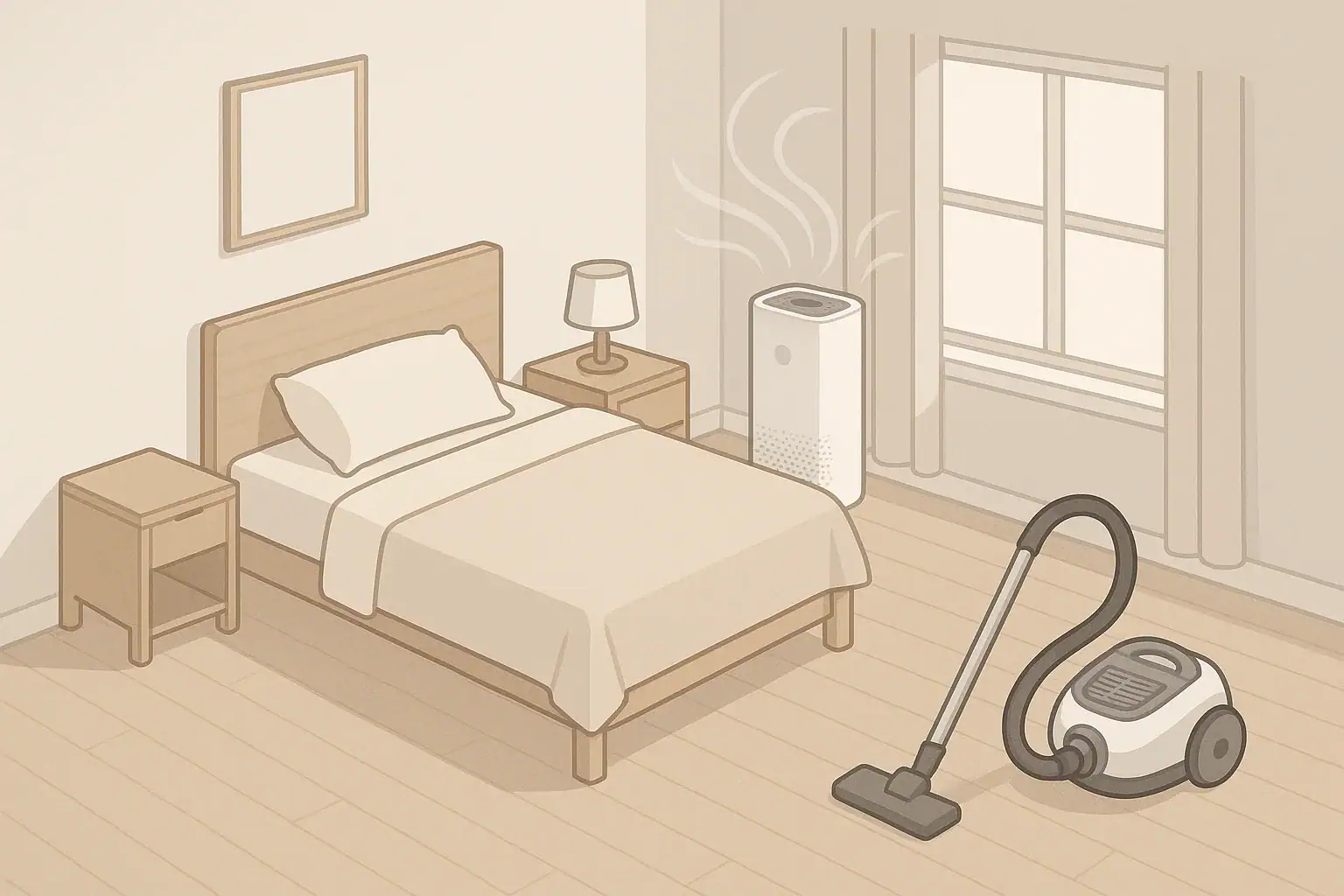
For most indoor allergies, a good air purifier does more continuous work on airborne particles, while a HEPA vacuum is better for removing allergens trapped in carpets, upholstery, and dust.
Both tools handle different parts of the problem: air purifiers reduce particles floating in the air, and HEPA vacuums remove settled dust and allergen reservoirs. Using them together usually gives more benefit than choosing only one, especially in carpeted homes or where pets and dust build up quickly.
- For airborne allergens (pollen, fine dust, smoke), an air purifier with a high-efficiency HEPA-type filter and enough CADR for the room usually helps more.
- For carpets, rugs, and upholstery allergens (dander, dust mite debris), a vacuum with a sealed HEPA system and strong suction is more effective.
- General target: aim for about 4–5 air changes per hour (ACH) from a purifier in bedrooms and main living areas, if noise and cost allow.
- Vacuum high-traffic and sleeping areas at least once per week; 2–3 times per week if you have pets or heavy dust.
- For many homes, the most practical setup is: a correctly sized air purifier running most of the time plus regular HEPA vacuuming and dusting.
How HEPA Vacuums and Air Purifiers Help with Allergies
Indoor allergies are often triggered by particles such as dust mite debris, pet dander, and pollen that enter the home or build up on surfaces. These allergens can float in the air for a while, then settle on floors, beds, and furniture, and later get stirred back up.
Air purifiers and HEPA vacuums both target particles but in different locations and time frames:
- Air purifiers continuously pull room air through filters to remove particles while they are airborne.
- HEPA vacuums focus on removing dust and allergen reservoirs from carpets, rugs, mattresses, and upholstery.
Because allergens move between air and surfaces, managing them usually requires attention to both. The question is not only which one helps more overall, but which is more important for your specific home and allergy triggers.
Key Concepts: What Each Device Actually Does
Understanding the basics of how HEPA vacuums and air purifiers work makes it easier to choose where to invest and how to size or use them.
HEPA Air Purifiers: Focus on Airborne Particles
An air purifier for allergies typically includes:
- A pre-filter to catch larger dust and hair
- A HEPA or HEPA-type filter to capture fine particles (dust, pollen, pet dander, many smoke particles)
- Sometimes an activated carbon filter to reduce some odors and gases (not a particle filter)
Key performance ideas:
- Clean Air Delivery Rate (CADR): An estimate of how much clean air the purifier delivers per minute for particles. Higher CADR generally means faster cleaning, if noise and energy use are acceptable.
- Air changes per hour (ACH): How many times per hour the purifier can theoretically filter the air in a room. For allergy-focused use, many people aim for around 4–5 ACH as a practical starting point.
- Filter quality and seals: A high-grade filter only works well if air is forced through it instead of leaking around it.
HEPA Vacuums: Focus on Surfaces and Dust Reservoirs
A vacuum marketed with HEPA filtration is more useful for allergies when it has a sealed system, meaning the air entering the vacuum leaves only through the filters, not through gaps in the body or hose.
Important features and concepts for vacuuming allergy-related dust:
- Sealed HEPA filtration: Captures fine dust instead of blowing it back into the room.
- Suction and agitation: Strong suction plus a brush roll or other agitation helps lift particles from carpet fibers and upholstery.
- Bagged vs bagless: Bagged systems can be less messy when emptying, while bagless bins may release more dust if not handled carefully.
Vacuuming is particularly important for homes with wall-to-wall carpet, thick rugs, or fabric upholstery, where allergens can accumulate deeply and remain for long periods if not removed.
Example values for illustration.
| Aspect | HEPA Air Purifier | HEPA Vacuum |
|---|---|---|
| Main target | Airborne particles (pollen, fine dust, some dander) | Settled dust and embedded allergens (carpets, fabrics) |
| Where it works | Open air in a room | Floors, rugs, furniture, mattresses |
| How often it runs | Often many hours per day | Typically 1–3 times per week per area |
| Key spec to check | CADR and ACH example targets | Sealed HEPA system and suction performance |
| Best suited for | Bedrooms, living rooms, open-plan spaces | Carpeted rooms, pet areas, beds, sofas |
| Typical limitation | Does not clean dust from carpets or surfaces | Works only where you physically vacuum |
| Noise pattern | Continuous, lower-level fan sound | Louder, short sessions while cleaning |
Where Each Helps More: Common Home Scenarios
Which helps more for allergies depends on your surfaces, layout, and main triggers. Some typical situations:
Mostly Hard Floors, Minimal Fabrics
If your home has hard flooring with limited rugs and simple fabric furniture:
- Air purifier often gives the most noticeable improvement for airborne pollen, dust, and smoke.
- Vacuuming still matters but may be less central than in a heavily carpeted home.
Wall-to-Wall Carpet or Thick Rugs
Carpet and plush rugs act as large dust and allergen reservoirs:
- HEPA vacuum becomes essential for pulling allergens out of fibers.
- Air purifier complements vacuuming by reducing particles that become airborne when people walk or play on the carpet.
Pets That Shed Dander or Hair
With indoor cats or dogs, both devices often have clear roles:
- HEPA vacuum for removing hair, dander, and tracked-in outdoor pollen from floors, pet beds, and furniture.
- Air purifier for reducing airborne dander and fine particles stirred up by movement.
Seasonal Pollen or Outdoor Air Issues
When outdoor air has high pollen or smoke levels and you keep windows mostly closed:
- Air purifier usually provides the primary benefit for indoor allergen and fine particle reduction.
- Vacuuming helps remove pollen that settles after entering through doors, clothing, or ventilation.
Common Mistakes When Relying on Just One Device
Many homes rely heavily on either vacuuming or purification and overlook the other. A few frequent issues:
- Using a non-HEPA or unsealed vacuum that stirs up fine dust and re-releases it into the air.
- Running a small air purifier in a large room and assuming it covers the whole space when it is undersized.
- Placing an air purifier in a corner with blocked airflow, reducing its effective reach.
- Rare or rushed vacuuming, allowing dust and allergens to build up deep in carpets and upholstery.
- Infrequent filter replacement, which can reduce performance for both vacuums and purifiers.
A combination approach—properly sized purifier plus consistent HEPA vacuuming—usually addresses both airborne and settled allergens more effectively than focusing entirely on one device.
Practical Checklist: Choosing and Using Each Tool
A simple way to decide where to focus is to look at your rooms, surfaces, and how sensitive you are to dust and pollen levels.
When to Prioritize an Air Purifier
Consider making the air purifier your first purchase or upgrade if:
- Your main concern is airborne pollen, fine dust, or smoke.
- You spend long periods in a few key rooms (bedroom, office, living room).
- Windows are often closed, so indoor air changes slowly without mechanical help.
- Floors are mostly hard surfaces, and dust is easy to mop or wipe.
Basic sizing idea:
- Estimate room area (length × width in feet) and ceiling height.
- Decide a target ACH, such as around 4–5 for allergy-oriented use, if practical.
- Use this to estimate the CADR you might need, keeping in mind that manufacturer numbers are examples and real performance depends on layout and placement.
When to Prioritize a HEPA Vacuum
Consider focusing on a HEPA vacuum if:
- You have carpeted bedrooms or living areas.
- There are pets that shed hair and dander on floors and furniture.
- You notice dust returning quickly to surfaces even with some air filtration.
- You have many fabric surfaces like upholstered furniture, thick curtains, and rugs.
Usage tips:
- Vacuum high-traffic rooms and bedrooms at least once a week; more frequently if you notice dust building up.
- Use tools designed for mattresses and upholstery for beds and sofas.
- Empty bags or bins carefully, ideally outdoors or over a lined trash can, to limit dust escape.
Combining Both for Better Results
For many households, the most balanced approach is:
- A suitably sized, properly placed air purifier running many hours per day in sleeping and main living areas.
- Regular HEPA vacuuming of floors, rugs, and upholstered furniture, plus periodic cleaning of mattresses and under beds.
- Basic dust control (damp dusting, washing bedding, and controlling clutter where dust collects).
Examples: How This Looks in Real Homes
Below are non-brand, simplified scenarios to show how HEPA vacuums and air purifiers might be used together.
Small Apartment with Mostly Hard Floors
- Surfaces: Hard floors, one rug in the living room, fabric sofa, standard bedding.
- Air purifier: One unit sized for the open living area and one smaller unit for the bedroom, aiming for around 4–5 ACH if noise is acceptable.
- Vacuuming: Weekly HEPA vacuuming of the rug, mattress, and sofa; sweeping or mopping hard floors.
Carpeted Suburban Home with Pets
- Surfaces: Wall-to-wall carpet upstairs, area rugs downstairs, two indoor pets.
- Air purifier: Units in bedrooms and the main living area, sized to provide multiple air changes per hour.
- Vacuuming: HEPA vacuum used 2–3 times per week in high-traffic paths, pet areas, and bedrooms; pet beds washed as part of routine.
Seasonal Pollen in a Bedroom-Focused Setup
- Surfaces: Mixed flooring, main concern is pollen during certain months.
- Air purifier: Focus on the bedroom, running before bedtime and overnight, with enough CADR to turn over the room air several times per hour.
- Vacuuming: Weekly HEPA vacuuming of bedroom carpets or rugs, especially near doors and windows; frequent washing of bedding.
Safety, Noise, and Standards Considerations
Safety and comfort are key when running equipment many hours per week.
- Ozone: For air purifiers, many people prefer units that do not intentionally generate ozone. Check that the device is intended for particle filtration rather than ozone-based air treatment.
- Ionizers and UV-C: Some purifiers include ionizer or UV-C features. These can change particle behavior or act on microorganisms, but they are not a replacement for good mechanical filtration. Use manufacturer controls as directed and disable optional features if they cause irritation or concern.
- Noise levels: Higher fan speeds increase CADR but also noise. In bedrooms, people commonly use lower speeds at night and higher speeds during the day.
- Electrical safety: For both vacuums and purifiers, use grounded outlets where appropriate, avoid pinching cords under furniture, and follow all basic safety instructions.
Maintenance and Cost Planning for HEPA Vacuums and Purifiers
Both devices depend heavily on maintenance. Clogged filters or full bags reduce performance and can stress motors.
Air Purifier Maintenance
- Pre-filters: Often washable or vacuumable. Cleaning them regularly can extend the life of the main filter.
- HEPA filters: Have a recommended replacement interval (for example, every 6–12 months in typical use), but real life depends on dust levels and run time.
- Carbon filters: Typically need more frequent replacement than HEPA filters to remain effective for odors and some gases.
- Exterior cleaning: Wipe grilles and intakes gently to keep airflow unobstructed.
Vacuum Maintenance
- Bags or bins: Replace or empty before they are packed full; suction often drops as they fill.
- Filters: Many vacuums have pre-motor and exhaust filters in addition to a HEPA filter; follow replacement or cleaning directions.
- Brush roll: Remove hair and fibers that wrap around the brush to maintain agitation and prevent motor strain.
Factoring in filter and bag costs ahead of time helps avoid stretching replacement intervals too far, which can reduce the effectiveness of both vacuums and air purifiers.
Simple Planner: Filter Replacement for Allergy-Focused Use
The table below shows general, non-brand examples of how often filters might be replaced under typical home conditions; actual needs vary based on dust, pets, and runtime.
Example values for illustration.
| Filter type | Typical interval range | What changes it | Reminder idea |
|---|---|---|---|
| Air purifier pre-filter | Clean every 1–3 months | Heavy dust, pet hair, nearby roads | Check when you notice visible dust buildup |
| Air purifier HEPA filter | About 6–12 months | Daily runtime hours, indoor dust level | Set a calendar reminder twice per year |
| Air purifier carbon filter | About 3–6 months | Cooking odors, smoking, chemicals used indoors | Replace when odors linger more than usual |
| Vacuum bag | When 1/2–3/4 full | Pet hair, large debris, carpeted area size | Check bag level every few uses |
| Vacuum HEPA exhaust filter | About 6–12 months | Frequency of vacuuming, fine dust load | Review at the same time as purifier HEPA filters |
| Vacuum pre-motor filter | Clean or replace every 3–6 months | How often you vacuum and dust level | Inspect when suction seems reduced |
Related guides: How to Choose the Right Air Purifier for Your Room Size • Air Purifier Placement: Where to Put It for Best Results • Bedroom Allergy Setup: The Fastest Changes That Reduce Symptoms
Summary: HEPA Vacuum vs Air Purifier for Allergies
For allergies related to indoor air quality, an air purifier and a HEPA vacuum address different but connected sources of exposure. Air purifiers work best on airborne particles, especially in rooms where you spend many hours, while HEPA vacuums are critical for removing allergen reservoirs in carpets, rugs, and upholstery.
If you must choose one, think about your floors, fabrics, and main concerns: a well-sized air purifier often stands out in homes with hard floors and strong pollen or smoke seasons, while a sealed HEPA vacuum can be more impactful in carpeted, pet-friendly homes. Whenever possible, combining a properly sized purifier with regular HEPA vacuuming and basic dust control creates a more comprehensive approach to managing indoor allergens over time.
Frequently asked questions
Can an air purifier replace HEPA vacuuming for carpeted rooms?
No. Air purifiers reduce airborne particles but do not remove allergens embedded in carpets, rugs, and upholstery. In carpeted rooms a sealed HEPA vacuum is needed to extract settled allergens; using both provides the best control.
How do I calculate the right size air purifier for allergy relief?
Estimate the room volume (area times ceiling height) and choose a purifier that can deliver your target ACH—many people aim for about 4–5 ACH for allergy-focused use. You can use CADR ratings or manufacturer room coverage as a guide and place the unit with unobstructed airflow for best results.
Are all “HEPA” vacuums equally effective for allergies?
No. Effectiveness depends on having a true HEPA filter plus a sealed airflow path so dust doesn’t escape around gaps, and adequate suction and agitation to lift particles from fibers. Bagged designs can reduce exposure during disposal, but regular maintenance and correct filter replacement are important for any model.
How often should I run an air purifier and vacuum to control allergies?
Run an air purifier for many hours per day in key rooms, including overnight in bedrooms if practical, to maintain lower airborne particle levels. Vacuum high-traffic and sleeping areas at least once a week, increasing to 2–3 times weekly if you have pets or heavy dust loads.
Will an air purifier help with pet dander if I can’t vacuum frequently?
An air purifier will reduce airborne pet dander but cannot remove dander that has settled into carpets and upholstery. For the best results, combine continuous air filtration with periodic HEPA vacuuming and washing of pet bedding.
Recommended next:
- Pet Dander Allergy: Best Air Cleaner Setup and Habits That Help
- Dust Mite Allergy: Humidity Targets, Bedding, and Filtration
- Asthma Triggers Indoors: A Practical Checklist to Improve Air Quality
- Bedroom Allergy Setup: The Fastest Changes That Reduce Symptoms
- Pollen Season Indoor Plan: Filters, Ventilation Timing, and Cleaning
- Dust Mites and Humidity: The RH Range That Helps Most
- More in Allergies & Asthma →
- Clear sizing logic (room size → CADR/ACH)
- HEPA vs carbon explained for real use-cases
- Humidity + ventilation basics to reduce mold risk