
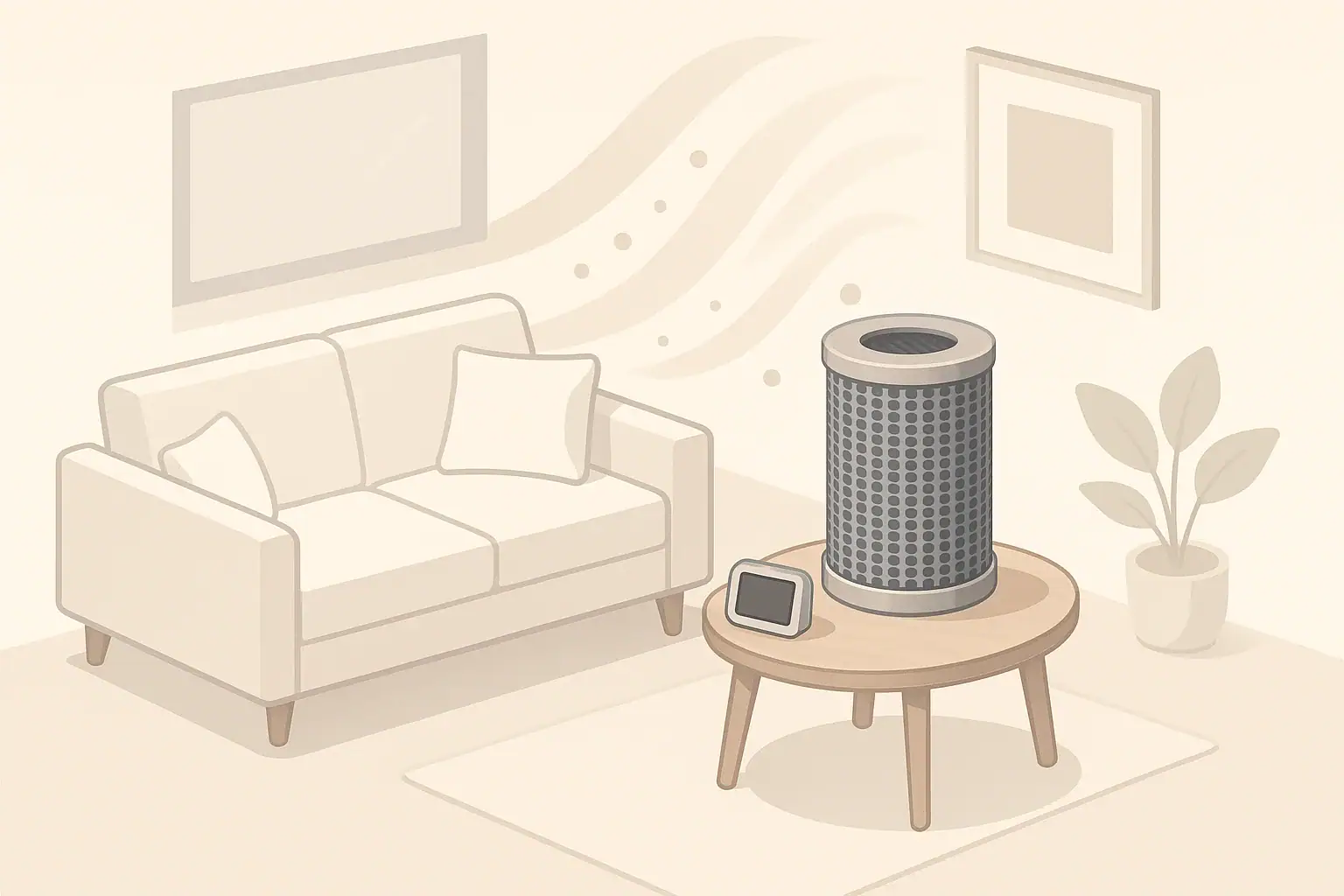
VOC sensors estimate total volatile organic compounds (TVOC) in the air, but they do not measure every individual VOC directly and their readings are only an approximate indicator of overall gas pollution and ventilation needs.
Many home air quality monitors now show a single “TVOC” number, which can be confusing when you learn how complex VOC chemistry really is. Understanding what these sensors can and cannot detect helps you use TVOC readings as a practical guide for ventilation, filtration, and source control rather than as a precise measure of risk.
- Most consumer TVOC sensors respond mainly to alcohols and similar gases, not all VOCs equally.
- Use TVOC trends (up, down, stable) more than any single exact number.
- In a typical home, aim to keep TVOC in your monitor’s lowest or second-lowest “comfort” band, if it has one.
- Spike after cooking, cleaning, or painting? Ventilate and, if possible, use activated carbon filtration.
- Persistent high readings despite ventilation may signal a strong source (new materials, odors) to investigate.
What VOCs and TVOC Readings Really Mean
Volatile organic compounds (VOCs) are a wide group of carbon-based chemicals that evaporate easily at room temperature. They come from building materials, paints, cleaning products, scented items, cooking, and even people and pets. Some have strong odors, others are odorless; some are considered more concerning than others.
“TVOC” stands for total volatile organic compounds. On professional instruments, this might be calculated from detailed lab measurements. On most home devices, however, TVOC is a sensor-derived index: the device measures a change in an electronic sensor and then converts that into an estimated concentration or into a color/quality band.
Why this matters for a home:
- Your monitor’s TVOC value is not a full chemical analysis of your air.
- It is better viewed as a “gas pollution level” indicator than as an exact number.
- It is most useful for spotting changes when you cook, clean, or open windows.
How Common Home VOC Sensors Work (and Their Limits)
Most consumer-grade VOC sensors fall into two families: metal-oxide semiconductor (MOS) and photoionization detector (PID). In home monitors, MOS sensors are more common because they are compact and relatively inexpensive.
Metal-oxide semiconductor (MOS) sensors
MOS sensors use a heated metal-oxide surface whose electrical resistance changes when certain gases are present. The device measures this change and, based on factory calibration with a reference gas (often ethanol), converts it to an estimated TVOC value.
Key characteristics:
- Broad sensitivity: Responds to many alcohols and some other organic vapors, but not equally to all VOCs.
- Humidity and temperature effects: High humidity or quick temperature shifts can change readings.
- Drift over time: Sensor response can slowly change and often requires periodic auto-calibration.
Photoionization detectors (PID)
PIDs use ultraviolet light to ionize certain gases, then measure the resulting current. They are more common in professional or industrial tools and can be more sensitive across a wider VOC range.
In a typical home setting, PIDs may:
- Offer more linear response over a range of VOCs.
- Still require calibration and interpretation; they also use reference gases.
In both cases, the sensor is seeing a mixture of gases and converting it into a single indicator. It cannot tell you which specific VOCs are present.
| Sensor type | Where commonly used | Strengths | Limitations |
|---|---|---|---|
| Metal-oxide semiconductor (MOS) | Most consumer indoor monitors | Small, low power, responds to many household gases | Sensitive to humidity, rough TVOC estimate, sensor drift |
| Photoionization detector (PID) | Professional and industrial tools | Higher sensitivity, better linearity across some VOCs | More expensive, needs calibration, still not speciation |
| Electrochemical gas sensors | Special gases (e.g., CO, NO2) | Good for specific target gases | Not used for broad “TVOC” monitoring |
| Laboratory analytical methods | Research, detailed IAQ assessments | Identifies individual VOCs and concentrations | Not continuous, higher cost, needs lab support |
Example values for illustration.
Why “Real VOCs” and TVOC Numbers Don’t Always Match
A TVOC reading suggests how much “sensor-detectable gas” is present, but your air can contain VOCs the sensor barely sees, and vice versa. Several factors create mismatches between readings and “real” VOC composition.
Calibration with a single reference gas
Many MOS sensors are calibrated using one gas (such as ethanol). The monitor assumes that a given signal change corresponds to a certain TVOC level, as if the air were mostly that reference gas. In a home, the actual VOC mix may include solvents, fragrances, cooking byproducts, and more, each with different sensor responses.
The result: 200 ppb on your monitor does not necessarily mean 200 ppb of any particular VOC. It is an indexed estimate, best used for relative comparison.
Strong sources vs. weak background
Short bursts of activities like cleaning or painting can produce high sensor responses. Background emissions from furniture, flooring, or stored products may keep readings elevated for hours or days, even if you do not smell much.
On the other hand, some VOCs can be present at relevant levels but have a weak response on the specific sensor in your device, so they barely change “TVOC.”
Interference from humidity and other gases
Changing relative humidity, temperature, or the presence of certain non-VOC gases can influence sensor outputs. Many monitors attempt to correct for this, but small drifts and jumps still occur.
This is why manufacturers often emphasize trends and categories such as “good,” “moderate,” or “poor” instead of exact numbers.
Common Mistakes When Interpreting TVOC Readings
Misreading a TVOC display can lead to unnecessary worry or, in some cases, a false sense of security. A few pitfalls show up repeatedly in home use.
Treating TVOC as an exact health metric
TVOC readings are not medical diagnostics. They do not tell you exactly how safe or unsafe your air is. Two homes with the same TVOC number may have very different VOC mixes and therefore different comfort implications.
Use TVOC as one input alongside odor, comfort, and ventilation habits, not as a standalone judge.
Ignoring baselines and drift
Many monitors “learn” a baseline when first powered on or after long stable periods, sometimes assuming that a long-term average equals clean air. If you set up a device in air that already contains elevated VOCs from new renovations or furniture, its future readings may understate changes.
Also, sensor output can drift over months. An apparent gradual “improvement” or “worsening” might be at least partly sensor aging rather than real air changes.
Overreacting to short spikes
Spikes when you cook with oil, use a spray cleaner, light candles, or open a solvent container are expected. Good practice is to ventilate during and after such activities, but a brief high reading is not, by itself, unusual in household life.
Practical Ways to Use TVOC Readings at Home
Despite limitations, TVOC readings are useful for shaping everyday habits. The key is to focus on trends, patterns, and practical adjustments.
Track patterns over time
- Note what activities precede higher readings: cooking, cleaning, hobbies, new products.
- Watch how quickly readings fall when you open windows or run exhaust fans.
- Look for persistent elevation that does not resolve with normal airing out.
Set simple comfort-oriented targets
Because displays differ (ppb, mg/m³, “index,” or color bands), a universal number target is not realistic. Instead:
- Aim to keep readings in whatever range your device labels as its baseline or “good” zone.
- Try to avoid staying in its highest zone for long periods, especially if associated with strong odors.
Use TVOC to guide actions, not anxiety
When readings go up and stay high compared to your usual baseline, you can:
- Increase natural ventilation (open windows, use cross-breezes when outdoor air is acceptable).
- Use kitchen and bathroom exhaust fans during and after emitting activities.
- Limit use of strong-smelling products, especially sprays and solvents, indoors.
- Consider an air purifier with sufficient activated carbon when odors or VOC sources are hard to avoid.
Examples: Real-World Scenarios with TVOC Sensors
Seeing how TVOC behaves in typical situations makes the readings more intuitive.
Scenario 1: Evening cooking in a small apartment
You cook with oil on the stove for 30 minutes without using the range hood. The TVOC reading climbs steadily, peaks shortly after cooking stops, and gradually declines over an hour.
What to do:
- Use the range hood when cooking if it vents outside.
- Open a nearby window during and after cooking when outdoor conditions are reasonable.
- If you rely on an air purifier, position it to promote airflow through or near the kitchen area.
Scenario 2: New furniture and paint in a bedroom
You have recently painted and brought in new furniture. The room smells “new,” and the TVOC reading is consistently higher than in other rooms, even with no recent activity.
What to do:
- Increase ventilation in that room for days or weeks (windows open when possible, door open to promote mixing).
- Run a purifier with activated carbon in or near that room to help reduce odors.
- Store any leftover paints, adhesives, or solvents in a well-ventilated area away from sleeping spaces.
Scenario 3: Cleaning day with multiple sprays
You use several cleaning sprays and scented products around the home. The TVOC reading spikes repeatedly and stays higher for a while, particularly in bathrooms and the kitchen.
What to do:
- Use exhaust fans while cleaning and for a short period afterward.
- Consider less volatile or fragrance-free alternatives where practical.
- Keep cleaning supplies sealed and stored in a ventilated or utility space if possible.
Safety, Standards, and What TVOC Does Not Show
There is no single universally accepted residential TVOC limit for all homes and situations. Organizations may publish reference ranges or guidelines for certain settings, but these are not simple pass/fail rules for every living room or bedroom.
TVOC vs. specific VOCs and gases
Some substances (for example, certain solvents or combustion byproducts) have well-studied exposure limits or guidelines. A broad TVOC sensor cannot tell if these are present individually. It may respond weakly or strongly depending on sensor chemistry.
If you have a specific concern about a certain chemical or source, a targeted measurement or professional assessment may be more appropriate than relying only on TVOC.
Ozone, ionizers, and UV-C devices
Some devices use ionization or UV-C lamps as part of their air treatment approach. These may or may not affect TVOC readings directly, depending on whether they change the kinds of gases present or interact with the sensor.
In general:
- Follow manufacturer safety instructions carefully and do not modify devices.
- Select equipment described as suitable for occupied spaces and avoid any product that intentionally produces notable ozone in those spaces.
- Understand that lowering a TVOC number on a monitor does not automatically mean all byproducts are reduced; chemistry can be complex.
Maintenance: Sensors, Filters, and Long-Term Accuracy
Over time, both sensors and filters can change behavior. Light maintenance goes a long way toward keeping your readings useful.
Keeping VOC sensors reliable
- Dust management: Gently dust around vents and openings on the monitor so air can flow freely.
- Placement: Avoid placing the monitor directly above strong sources (like cleaners) or in dead-air corners.
- Warm-up and stabilization: Some sensors need minutes to hours after power-up to stabilize; check the device manual.
- Firmware or app updates: When available, updates may improve auto-calibration or interpretation of readings.
Carbon filters and VOC reduction
Carbon or other sorbent filters in purifiers can help reduce certain VOCs and odors, but their capacity is finite. Once the sorbent material becomes saturated, its effectiveness decreases and may eventually decline sharply.
Plan for:
- Replacing carbon filters according to general manufacturer intervals, or sooner if strong odors return quickly.
- Recognizing that extremely heavy VOC loads (for example, strong solvents, heavy smoke) can use up sorbent capacity more quickly.
Cost planning
Consider the long-term cost of maintaining both monitoring and filtration:
- Occasional replacement of monitors or sensors over many years as performance drifts.
- Regular filter changes for purifiers, especially carbon components, based on usage and source strength.
FAQ: Using TVOC Alongside Other Air Quality Metrics
TVOC is one piece of a broader indoor air picture that also includes particles, humidity, and carbon dioxide (CO₂) from people breathing.
How should I combine TVOC with PM2.5 readings?
Fine particles (PM2.5) and VOCs come from some of the same activities, such as cooking or burning candles, but PM2.5 monitors look at particles while VOC sensors look at gases. If both PM2.5 and TVOC increase during an activity, improving ventilation and using a purifier with both particle filtration and carbon sorbent can be helpful.
What about CO₂ and TVOC together?
CO₂ levels from people breathing are often used as a rough indicator of how much fresh air is coming in. You can use CO₂ to judge general ventilation and TVOC to judge gas emissions from products and materials. A room with low CO₂ but high TVOC may have a strong local source; a room with high CO₂ and high TVOC may simply need better overall air exchange.
Should I move the monitor around or leave it in one place?
For understanding everyday background conditions, leaving one monitor in a consistent, representative spot is helpful. For diagnosing specific issues (for example, a smelly closet or a freshly renovated room), temporarily moving the monitor for comparison can reveal relative differences.
| Metric | What it mainly indicates | Common pitfalls | Action idea |
|---|---|---|---|
| TVOC | Overall gas emissions from products, materials, activities | Treating numbers as exact; ignoring trends and sources | Ventilate after spikes; limit strong chemical products |
| PM2.5 | Fine particles from smoke, cooking, outdoor pollution | Assuming low PM2.5 means air is entirely “clean” | Use high-efficiency filters; reduce indoor smoke sources |
| CO₂ | Fresh air rate relative to number of people | Confusing CO₂ with VOCs or particles | Open windows or adjust ventilation if consistently high |
| Humidity | Moisture levels affecting comfort and mold risk | Forgetting that humidity affects VOC and dust perception | Aim for a moderate range; use humidifier or dehumidifier as needed |
| Temperature | Thermal comfort and VOC evaporation rate | Ignoring that warmer air can increase VOC off-gassing | Keep rooms at comfortable, steady temperatures when possible |
Example values for illustration.
Related guides: How to Choose the Right Air Purifier for Your Room Size • Air Purifier Placement: Where to Put It for Best Results • When to Replace Carbon Filters (And How to Tell They’re Spent)
Summary: Using VOC Sensors Wisely at Home
TVOC readings from home monitors provide a helpful, though imperfect, window into indoor gas pollutants and ventilation effectiveness. Sensors are calibrated to a few reference gases, drift over time, and cannot tell you exactly which VOCs are present. For that reason, it is more effective to treat TVOC as a trend indicator than as a precise measure.
Used alongside PM2.5, CO₂, humidity, and your own observations of odor and comfort, TVOC data can guide practical actions: ventilating during and after high-emission activities, selecting lower-emission products when feasible, and considering carbon-based filtration where persistent odors or sources are present. With realistic expectations, VOC sensors can support a calmer, more informed approach to indoor air quality management at home.
Frequently asked questions
What does a TVOC number on my home monitor actually represent?
A TVOC reading is a sensor-derived index estimating the combined response of volatile organic compounds that the monitor can detect, not a chemical breakdown. It reflects how the sensor’s chemistry and calibration react to the current gas mixture, so it is most reliable for showing trends rather than exact concentrations of specific compounds.
Why does TVOC jump after cooking but then fall after an hour?
Cooking releases a mix of gases and aerosols that many VOC sensors respond to, producing a temporary spike. Ventilation, dilution, and natural settling reduce concentrations over time, so readings usually decline within an hour if you ventilate or run exhaust fans.
How should I respond if my TVOC stays elevated for days?
Start by identifying likely sources (new furniture, ongoing painting, stored chemicals) and increase ventilation in that area; run a purifier with activated carbon if odors persist. If elevated readings continue despite source control and airing out, consider targeted testing or a professional indoor air assessment for specific compounds.
Can TVOC monitors detect dangerous gases like carbon monoxide or confirm formaldehyde levels?
No, carbon monoxide is not a VOC and requires a dedicated CO alarm; some important compounds like formaldehyde may not be accurately quantified by general TVOC sensors. For health-critical or legally regulated pollutants, use purpose-built sensors or laboratory analysis.
How often should I check or recalibrate my TVOC monitor and replace carbon filters?
Sensors typically need only occasional attention but can drift over months; follow device guidance for firmware updates and baseline checks, and allow warm-up time after powering on. Replace carbon filters according to usage and manufacturer guidance, often in the range of a few months to a year depending on source strength and frequency.
Recommended next:
- Activated Carbon Filters Explained: VOCs, Odors, and What They Can’t Do
- How Much Activated Carbon Do You Need to Remove Odors?
- Carbon Filter vs HEPA: What Each One Removes (And What It Doesn’t)
- Formaldehyde in Homes: Sources, Risks, and How to Reduce It
- Activated Carbon Types: Pellet vs Granular vs Impregnated Carbon
- How Much Carbon Do You Need for Odors? Weight, Depth, and Contact Time
- More in Carbon Filters & VOCs →
- Clear sizing logic (room size → CADR/ACH)
- HEPA vs carbon explained for real use-cases
- Humidity + ventilation basics to reduce mold risk