
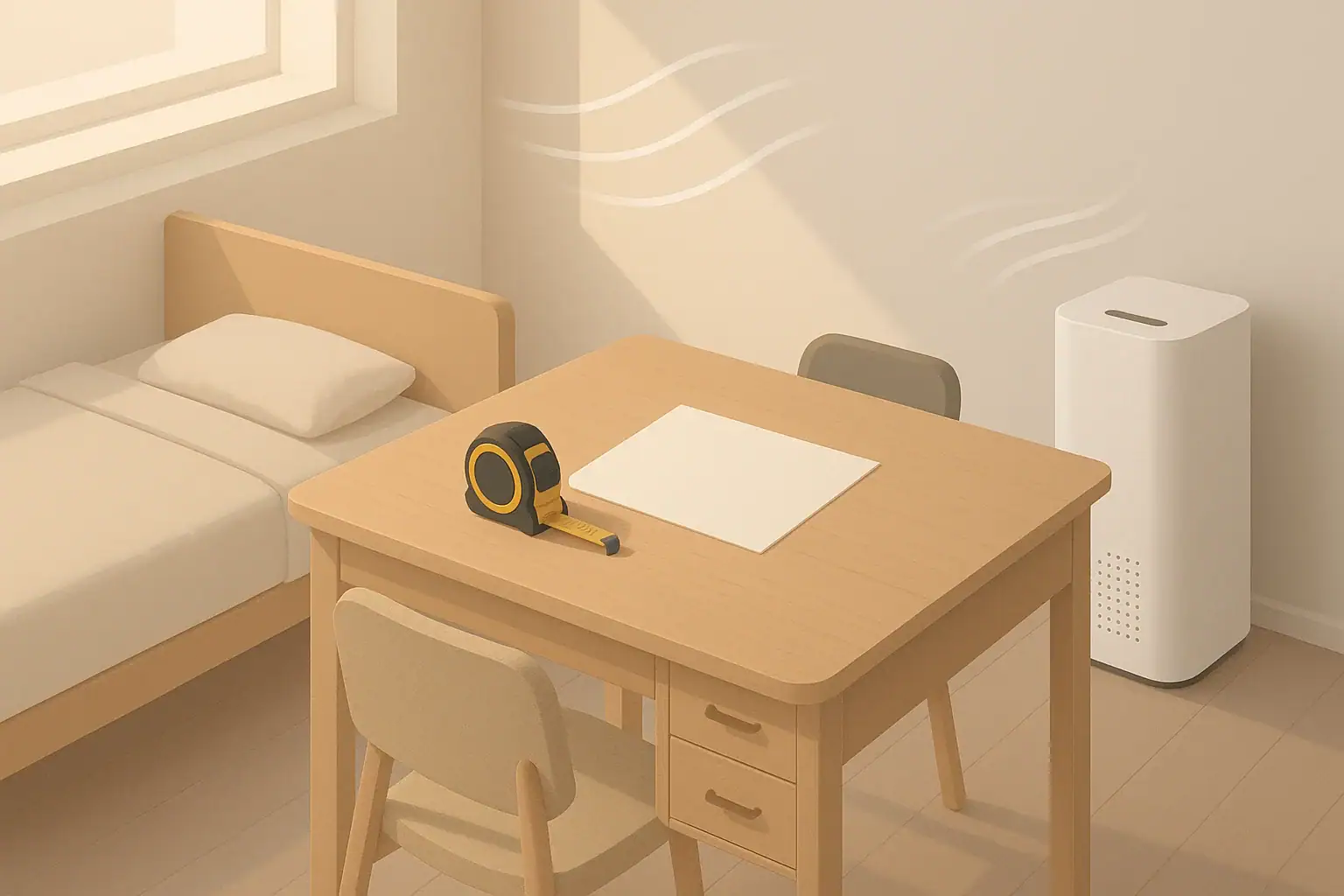
Most bedrooms feel comfortable for sleep at roughly 3–5 air changes per hour (ACH), with about 2–3 ACH as a reasonable minimum and up to 6–8 ACH in special cases like smoke events. In plain terms, that means the bedroom air is filtered or replaced a few times each hour so particles, odors, and stuffiness do not build up overnight.
Because we spend long, continuous hours in the bedroom with doors and windows often closed, the air can slowly accumulate exhaled carbon dioxide, fine particles, and indoor odors. Targeting a sensible ACH using ventilation and an air purifier helps keep bedroom air fresher without turning the room into a noisy wind tunnel.
This guide explains what bedroom ACH for sleep really means, how to estimate it with simple numbers, and how to adjust fan speeds, placement, and filters so you get cleaner air, manageable noise, and a routine that is easy to live with night after night.
What ACH Means in a Bedroom and Why It Matters for Sleep
Air changes per hour (ACH) describes how many times in one hour the air in a room is effectively replaced or cleaned. In a bedroom, this can come from outdoor air (ventilation) or from recirculating indoor air through filters (filtration). The goal is not to hit a single exact number, but to reach a range that keeps the room from feeling stale or dusty while still being quiet enough to sleep.
During sleep, people continue breathing, shedding skin flakes, and stirring up dust in bedding and carpet. Building materials and furnishings can also release low levels of gases. With the door mostly closed, these pollutants can accumulate unless the air is diluted or filtered at a reasonable rate.
Thinking in terms of ACH helps you:
- Size an air purifier for your bedroom instead of guessing based on marketing labels.
- Understand how open or closed doors and windows change your effective air change rate.
- Balance cleaner air with noise, drafts, and energy use so the setup actually works for sleep.
Most bedrooms end up in a practical range of about 3–5 ACH when using a moderately sized purifier plus whatever background ventilation the home already provides.
Key Concepts: How Bedroom ACH for Sleep Is Calculated and Adjusted
To estimate bedroom ACH for sleep, you mainly need room volume and airflow. From there, you can adjust fan speed, placement, and filter type to dial in comfort.
Step 1: Estimate Bedroom Volume
Measure or approximate three dimensions in feet:
- Length
- Width
- Ceiling height
Then calculate:
Room volume (ft³) = length × width × height
Example: A 12 × 14 bedroom with an 8-foot ceiling has a volume of 12 × 14 × 8 = 1,344 cubic feet.
Step 2: Connect Airflow to ACH
Airflow is typically given in cubic feet per minute (CFM) for fans and in CFM-like values for air purifiers. The relationship to ACH is:
ACH ≈ (CFM × 60) ÷ room volume
Using the 1,344 ft³ bedroom example:
- 60 CFM → ACH ≈ (60 × 60) ÷ 1,344 ≈ 2.7 ACH
- 90 CFM → ACH ≈ (90 × 60) ÷ 1,344 ≈ 4.0 ACH
These are planning numbers. Actual ACH can be lower if filters are clogged or if the fan is weaker than rated.
Step 3: Using CADR as a Practical Shortcut
Clean air delivery rate (CADR) for particles is often listed in cubic feet per minute, similar to CFM. For bedroom air quality, you can treat the particle CADR as the effective airflow of clean air in the ACH formula, understanding that it is based on standardized test conditions.
For example, if a purifier lists a smoke CADR of 120 CFM in a 1,344 ft³ bedroom:
- ACH for particles ≈ (120 × 60) ÷ 1,344 ≈ 5.4 ACH (illustrative)
This gives a rough idea of how frequently fine particles are being filtered, which is helpful during pollen season or smoke events.
Step 4: Balancing ACH with Noise and Airflow Feel
Higher speeds usually increase ACH and noise. For sleep, many people prefer to:
- Run a higher fan speed for 30–60 minutes before bedtime to clear the air.
- Switch to a lower, quieter speed overnight that still keeps ACH in the general target range.
- Place the purifier several feet away from the bed to soften both sound and airflow on the body.
The best bedroom ACH for sleep is the one you can actually tolerate all night, not just the highest number you can calculate on paper.
| Bedroom size (ft) | Approx. volume (ft³) | Target ACH range | Approx. clean airflow needed (CFM) |
|---|---|---|---|
| 10 × 10 × 8 | 800 | 3–5 ACH | 40–67 CFM |
| 11 × 13 × 8 | 1,144 | 3–5 ACH | 57–95 CFM |
| 12 × 14 × 8 | 1,344 | 3–5 ACH | 67–112 CFM |
| 14 × 16 × 8 | 1,792 | 3–5 ACH | 90–149 CFM |
| 15 × 18 × 9 | 2,430 | 3–5 ACH | 122–203 CFM |
Real-World Bedroom ACH Examples and Scenarios
Once you know roughly how ACH works, the next step is to see how it plays out in everyday bedrooms. The right target depends on room size, how tight the home is, and what you are trying to control.
Scenario 1: Typical Bedroom with Mild Outdoor Air
Consider a 12 × 14 × 8 bedroom (1,344 ft³) in a home with a central HVAC system that runs occasionally overnight. The bedroom door is mostly closed, but there is a supply register and a return in the hallway. A small purifier provides about 80 CFM of clean airflow on a low setting.
- Purifier-only ACH ≈ (80 × 60) ÷ 1,344 ≈ 3.6 ACH
- Plus some additional background ventilation from the HVAC system
This setup often feels fine for most sleepers, with modest dust buildup and minimal odor accumulation.
Scenario 2: Bedroom with Pets and Dust Buildup
Now take a similar room with two pets that sleep on the bed. Bedding and carpet collect fur and dander, and dust on furniture becomes noticeable within a few days.
- Raising ACH to around 4–6 for particles can help slow visible dust buildup.
- This might mean running the purifier at a medium speed instead of low, or using a slightly higher-capacity unit.
Practical cue: If you are vacuuming and dusting more often than you would like, and the room still looks dusty, that is a sign your effective ACH for particles may be on the low side.
Scenario 3: Seasonal Smoke or Regional Haze
During wildfire smoke or regional haze, outdoor air may contain high levels of fine particles. In this case, it is common to:
- Keep windows and exterior doors closed as much as practical.
- Rely more heavily on filtration-based ACH from an air purifier.
- Aim for the higher end of the range, about 5–8 ACH for particles, if noise is tolerable.
In a 1,344 ft³ bedroom, that might require 112–180 CFM of clean airflow for the duration of the smoke event, then returning to quieter settings when outdoor conditions improve.
Scenario 4: Tightly Sealed Room with Little Ventilation
Some modern bedrooms are very tight, with upgraded windows and weatherstripping. If the door is closed all night and there is limited fresh air supply, carbon dioxide and odors from people and furnishings can build up even if particles are well controlled.
In this situation, a purifier can keep particles low, but adding some scheduled ventilation when outdoor air is acceptable (for example, opening a window for 10–20 minutes in the evening or morning) helps dilute gases and support comfort over the long term.
| What you notice in the bedroom | Likely ACH-related cause | Practical adjustment to try |
|---|---|---|
| Air feels stuffy in the morning | Low overall air change rate, especially for fresh air | Increase ventilation time when outdoor air allows; slightly open door or run HVAC fan longer |
| Dust returns quickly on surfaces | Particle ACH likely too low for room size and sources | Raise purifier speed or use higher-capacity unit to reach ~4–6 ACH for particles |
| Noise from purifier disturbs sleep | ACH set high using loud fan speed | Pre-clean room at high speed, then switch to quieter setting overnight; adjust placement |
| Cool draft felt on face or body | Airflow directed too strongly at the bed | Reposition purifier, angle outlet away from bed, or use lower nighttime speed |
| Odors linger even with purifier running | ACH may be adequate for particles but not enough ventilation or gas removal | Add periods of fresh air ventilation and consider filters designed for gases and odors |
Common Bedroom ACH Mistakes and Troubleshooting Cues
Even with the right target range in mind, it is easy to misjudge how ACH behaves in a real bedroom. Watching for specific cues can help you troubleshoot.
Mistake 1: Sizing Only by Square Footage
Many people size purifiers by floor area alone and ignore ceiling height. A tall bedroom has more volume than a low one with the same floor size, which reduces ACH for a given airflow.
Troubleshooting cue: If you followed a square-foot chart but the room still feels dusty or stale, check your ceiling height and recalculate volume to see if your actual ACH is lower than expected.
Mistake 2: Ignoring Door Position
A bedroom with the door open behaves differently from one that is closed tightly all night. An open door can allow more mixing with the rest of the house, which may increase or decrease perceived air quality depending on how clean the rest of the home is.
Troubleshooting cue: If the bedroom feels better on nights when the door is cracked open, your closed-door ACH may be too low, especially for fresh air. Consider modest increases in filtration or scheduled ventilation.
Mistake 3: Running on High All Night and Then Giving Up
Some people try a purifier on its highest setting, find it too loud for sleep, and stop using it altogether. This often leads to giving up on ACH targets entirely.
Troubleshooting cue: If noise is the main barrier, use a two-step approach: pre-clean on high, then run on low or medium overnight. You may still achieve 3–4 ACH quietly, which is a large improvement over not running the device at all.
Mistake 4: Forgetting About Filter Condition
As filters load with dust, airflow can drop. That means your estimated ACH based on new filter ratings may no longer be accurate.
Troubleshooting cue: If the purifier sounds more strained, airflow from the outlet feels weaker, or dust starts accumulating faster than before, it may be time to clean pre-filters or replace main filters to restore closer-to-rated ACH.
Mistake 5: Over-Focusing on a Single Number
ACH is a helpful planning tool, but it is not the only factor. Humidity, temperature, bedding cleanliness, and noise sensitivity also affect sleep comfort.
Troubleshooting cue: If your calculated ACH looks fine but the room still feels uncomfortable, consider other variables such as humidity (too dry or too humid), bedding washing frequency, and noise patterns from fans or outdoor sources.
Safety Basics When Increasing Bedroom Air Changes
Adjusting bedroom ACH for sleep is generally low risk, but a few safety basics help avoid unintended problems when you rely more on ventilation and fans.
Combustion Appliances and Backdrafting
If your home uses combustion appliances such as gas furnaces, water heaters, or unvented heaters, changing how you ventilate can affect pressure differences in the building. Strong exhaust fans or open windows in some areas may, in some cases, pull combustion gases back into the living space.
In most bedrooms, a single portable purifier does not create strong pressure differences. Still, if you add powerful exhaust ventilation near combustion appliances, it is wise to ensure those appliances are properly vented and inspected according to local guidance.
Ventilation and Outdoor Air Quality
Opening windows increases ACH with outdoor air. This is usually beneficial when outdoor air is reasonably clean and comfortable. However, during high outdoor pollution events (smoke, heavy traffic pollution, or strong odors), extra ventilation can bring more pollutants inside.
For bedroom air quality during such events, it is often safer to keep windows closed and rely more on filtration-based ACH from an air purifier until outdoor conditions improve.
Temperature, Drafts, and Sleep Comfort
Very high airflow directly on the body can feel cold, especially at night when metabolism slows. Strong drafts may disturb sleep even if the air is technically cleaner.
To reduce this risk:
- Aim the purifier outlet away from the bed instead of directly at it.
- Use lower speeds overnight, especially in smaller rooms where airflow feels more concentrated.
- Adjust bedding and room temperature to account for any added air movement.
Electrical and Placement Safety
When running fans or purifiers continuously at night, basic electrical safety still applies:
- Place devices on stable, flat surfaces where they will not tip over.
- Avoid draping bedding, curtains, or clothing over intakes and outlets.
- Keep cords out of walking paths to prevent tripping when getting up at night.
Long-Term Bedroom ACH: Maintenance, Filters, and Seasonal Adjustments
Maintaining a comfortable bedroom ACH for sleep is not a one-time calculation. Over months and seasons, filter condition, outdoor air quality, and home usage patterns change.
Filter Maintenance and ACH Stability
Filters gradually load with particles, which can reduce airflow and effective ACH. To keep performance closer to your target:
- Check pre-filters regularly and clean them according to manufacturer instructions.
- Replace main filters on schedule or when airflow and performance noticeably decline.
- Note how long it takes for dust to appear on bedroom surfaces as a practical indicator.
Seasonal Changes in Ventilation
Seasonal differences affect how you use windows and HVAC systems:
- Cool seasons: Windows may stay closed more often, so filtration plays a larger role in achieving desired ACH.
- Warm seasons: Windows may be open more often in mild weather, increasing ventilation-based ACH when outdoor air is acceptable.
You can adjust purifier settings seasonally, using higher filtration when windows are closed and moderating fan speeds when fresh outdoor air is readily available.
Monitoring Trends Over Time
Simple observations can tell you if your long-term bedroom ACH setup is working:
- How often you need to dust or vacuum the bedroom.
- Whether the room smells neutral or tends to hold onto odors.
- Whether you wake up feeling congested or clear, assuming other health factors are stable.
Some people also use basic indoor air quality monitors to watch general trends in particles or carbon dioxide. While these are not medical devices, they can show whether changes in fan speed or window use are moving conditions in the right direction.
Practical Takeaways and Specs to Look For
Bedroom ACH for sleep does not have to be complicated. A few clear targets and habits can keep air fresher with minimal effort.
Key takeaways:
- A practical bedroom ACH range for sleep is roughly 3–5, with 2–3 as a minimum for many situations and up to 6–8 during special events like smoke.
- Use room volume and airflow (CFM or CADR) to estimate ACH instead of guessing by room size alone.
- Combine filtration with reasonable ventilation when outdoor conditions allow, and rely more on filtration when outdoor air is poor.
- Balance ACH with noise and drafts by pre-cleaning on higher speeds and running quieter settings overnight.
- Revisit filter condition and seasonal habits to keep your setup effective over time.
Specs to Look For When Targeting Bedroom ACH
When you are choosing or adjusting equipment to meet your bedroom ACH target for sleep, these specs and features are especially useful:
- Clear airflow or CADR rating: Look for particle CADR values in CFM so you can plug them into the ACH formula for your specific room volume.
- Multiple fan speeds: At least three speeds (or a variable setting) make it easier to pre-clean on high and sleep on low or medium.
- Noise level information: Sound ratings at different fan speeds help you estimate whether a given ACH level will be comfortable at night.
- Filter type and efficiency: High-efficiency particle filters help each air change remove more fine particles; optional gas or odor media may be useful if smells are a concern.
- Filter access and replacement indicators: Simple access and reminders support consistent maintenance, which helps keep actual ACH closer to your target.
- Room-size guidance with ceiling height notes: Any sizing information that acknowledges ceiling height or volume gives you a better starting point than square footage alone.
- Continuous or timer modes: Timers or scheduling modes make it easier to run higher speeds before bedtime and quieter speeds overnight without constant manual adjustment.
By matching these specs to your room volume and comfort preferences, you can set a realistic bedroom ACH for sleep that keeps air clearer while still supporting a calm, quiet place to rest.
Frequently asked questions
What device specifications should I check to make sure an air cleaner can meet my bedroom ACH for sleep?
Look for the particle CADR or clear airflow (CFM), published noise levels at different speeds, and available fan speed settings. Use CADR/CFM with your room volume to estimate ACH and confirm the device can reach your target at an acceptable noise level.
Is sizing a purifier by square footage alone a common mistake?
Yes. Relying only on floor area ignores ceiling height and total room volume, which directly affect ACH. Always calculate room volume and use CFM/CADR to estimate effective air changes instead of using square-foot charts alone.
Are there safety concerns when I increase ventilation or filtration to raise bedroom ACH?
At a high level, adding filtration is low risk, but strong exhaust ventilation or frequent window opening can change building pressure and potentially affect combustion appliance venting. If you use significant exhaust or live with gas-burning appliances, ensure proper venting and follow local safety guidance.
How can I balance achieving target ACH with keeping noise low for sleep?
Run higher fan speeds for 30–60 minutes before bedtime to reduce particle load, then switch to a lower, quieter setting overnight that still provides some ACH. Position the unit away from the bed and choose devices with multiple speeds and published sound ratings to find a tolerable compromise.
How often should I inspect or replace filters to keep ACH stable?
Follow manufacturer recommendations but inspect pre-filters and main filters regularly; heavy use, pets, or smoky conditions may require more frequent service. If airflow drops, the fan sounds strained, or dust returns quickly, clean or replace filters to restore effective ACH.
- Clear sizing logic (room size → CADR/ACH)
- HEPA vs carbon explained for real use-cases
- Humidity + ventilation basics to reduce mold risk