
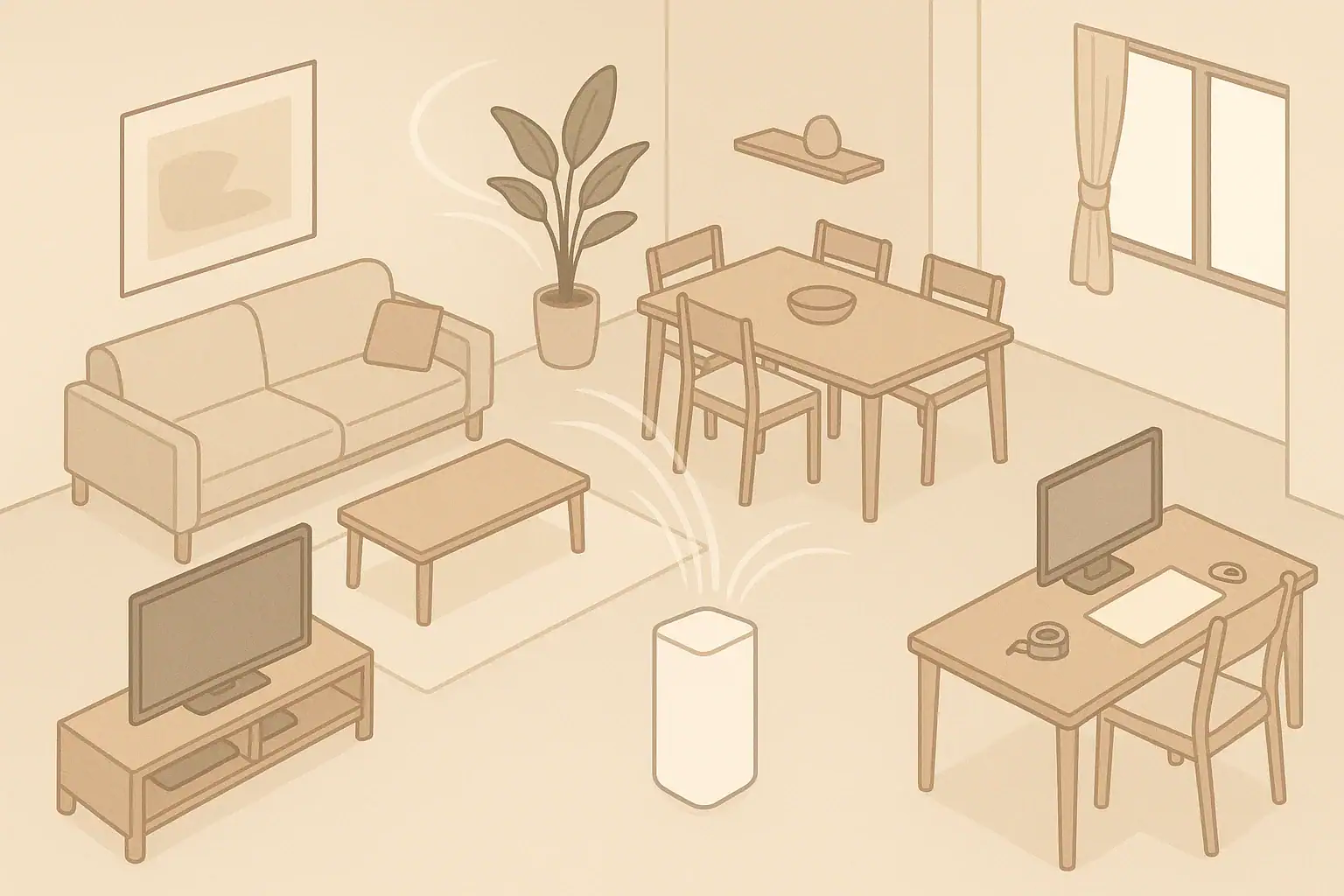
The simplest way to size an air purifier for an open floor plan is to calculate the total air volume, choose a target air changes per hour (ACH), and then convert that into the clean air delivery rate (CADR) you need. Once you know the CADR, you can decide whether one large unit or multiple smaller units will work best in your combined living, dining, and kitchen areas.
This method works for most open layouts, including great rooms, studios, and L-shaped living–dining spaces. It helps you avoid guessing based only on square footage or marketing labels. Instead, you use a repeatable process that accounts for ceiling height, how open the layout really is, and where pollutants such as cooking smoke or pet dander actually come from.
Below is a step-by-step guide to air purifier sizing for open floor plans, with concrete examples, tables, and troubleshooting cues you can adapt to your own home.
What Air Purifier Sizing Means in an Open Floor Plan (and Why It Matters)
In a closed room, air purifier sizing is fairly simple: you match one device to one room. In an open floor plan, the living room, dining area, kitchen, and sometimes hallways all share the same air. That shared air volume is what the purifier has to clean, and it is usually much larger than a single room.
Proper sizing for an open layout means:
- Calculating the combined air volume of the connected areas, not just one corner.
- Choosing a realistic ACH target based on how clean you want the air and how sensitive you are.
- Translating that into a total CADR and then splitting it across one or more purifiers.
This matters because undersized units may barely reduce particles in a busy great room, while oversized units may be too loud to run at useful speeds. Good sizing helps you balance comfort, noise, energy use, and cost while improving indoor air quality in the areas where your household spends the most time.
Key Concepts: ACH, CADR, and Open-Plan Volume
Before you apply any formulas, it helps to understand three core ideas: air changes per hour (ACH), clean air delivery rate (CADR), and total air volume in an open floor plan.
Air Changes per Hour (ACH)
ACH describes how many times per hour the purifier processes a volume of air equal to the space. Higher ACH generally means faster reduction of airborne particles such as dust, smoke, and pet dander.
- Lower ACH (2–3): Gentle background cleaning for low-pollutant homes.
- Moderate ACH (3–5): Common target for main living areas in homes with pets, cooking, and regular activity.
- Higher ACH (5–6+): Faster cleanup during events like wildfire smoke or heavy cooking, with more noise and energy use.
In open layouts, many people aim for the middle of this range for daily use and temporarily increase fan speed during pollution spikes.
Clean Air Delivery Rate (CADR)
CADR is a measure of how much clean air an air purifier delivers each minute, usually in cubic feet per minute (CFM). For sizing open floor plans, you mainly care about particle CADR, because that is what reduces fine particles from cooking, dust, and smoke.
Once you know your space volume and ACH target, you can estimate the CADR needed. As a planning rule:
CADR (CFM) ≈ Room volume (ft³) × ACH ÷ 60
This converts air changes per hour into how many cubic feet per minute of cleaned air you need.
Open-Plan Volume: Square Footage and Ceiling Height
Many open floor plans have higher or vaulted ceilings, so simple square footage ratings can underestimate what you need. For better accuracy, work in total air volume:
Volume (ft³) = Total open-plan floor area (ft²) × Average ceiling height (ft)
If your ceiling height varies (for example, 8 feet over the kitchen and 12 feet in the living room), estimate a reasonable average based on how much area each height covers.
| Input | What to measure or decide | Why it matters in an open floor plan |
|---|---|---|
| Total open floor area | Combined square footage of living, dining, kitchen, and connected halls | Defines the footprint of the shared air zone you are trying to clean. |
| Average ceiling height | Weighted average if ceilings vary (flat, tray, or vaulted) | Higher ceilings increase total air volume and required CADR. |
| Target ACH | Example: 3–5 ACH for everyday living areas | Higher ACH = faster cleaning but more noise and energy use. |
| Pollutant sources | Cooking, pets, fireplaces, nearby traffic, hobbies | Heavier sources may justify a higher ACH target or extra units. |
| Layout complexity | Simple rectangle vs. L-shaped, long, or multi-level | Complex layouts often benefit from multiple purifiers. |
| Noise tolerance | How loud is acceptable near seating and TV areas | Determines whether you rely on one large unit or several smaller ones. |
Real-World Sizing Examples for Open Floor Plans
Putting the concepts together, you can size air purifiers for different open layouts using the same basic steps: define the shared zone, calculate volume, choose ACH, and compute CADR. Then decide how to split that CADR across one or more units.
Step-by-Step Calculation for a Typical Great Room
Imagine an open-plan main floor with a living room, dining area, and kitchen that act as one shared air space.
- Living area: 15 ft × 18 ft = 270 ft²
- Dining area: 10 ft × 12 ft = 120 ft²
- Kitchen: 10 ft × 12 ft = 120 ft²
- Total floor area: 270 + 120 + 120 = 510 ft²
- Average ceiling height: 9 ft
Volume = 510 ft² × 9 ft = 4,590 ft³
If you choose a target of 4 ACH for this busy family space:
- CADR ≈ 4,590 × 4 ÷ 60
- CADR ≈ 18,360 ÷ 60
- CADR ≈ 306 CFM
You now know you want roughly 300 CFM of particle CADR in this open-plan area. That could mean one larger purifier that delivers around 300 CFM on a setting you can live with, or two smaller units that each deliver roughly 150–180 CFM at comfortable fan speeds.
Example Layouts and Possible Approaches
The same method applies to other open layouts. The table below summarizes a few common scenarios and how you might distribute CADR.
| Open-plan scenario | Approx. volume (ft³) | ACH target (example) | Estimated CADR needed (CFM) | Possible purifier setup |
|---|---|---|---|---|
| Small studio or efficiency apartment | 2,000 | 3–4 | 100–135 | One compact unit placed centrally, run continuously on medium. |
| Typical living–dining–kitchen great room | 4,500–5,000 | 3–5 | 225–415 | One larger unit near the center or two mid-sized units at opposite ends. |
| L-shaped open plan with busy kitchen | 5,500 | 4–5 | 365–460 | One unit near the kitchen boundary and one in the main seating area. |
| Open main floor plus connected stairwell | 6,500 | 3–4 | 325–435 | One main-floor unit and a second near the stair landing or upper hall. |
Placement Examples in Open Layouts
Once CADR is set, placement determines how evenly the clean air spreads:
- Rectangle great room: Place a single unit slightly off-center, away from tight corners, with a few feet of open space around the intake and outlet. If using two units, put them at opposite sides of the room, both in open airflow paths.
- L-shaped living–dining–kitchen: Place one purifier where the short and long parts of the “L” meet, and a second closer to the kitchen to catch cooking particles before they spread.
- Open plan with high ceilings: Combine a floor-level purifier with a ceiling fan on low to help mix air without creating drafts, which can improve how well clean air reaches the upper parts of the room.
Common Sizing and Placement Mistakes (and How to Fix Them)
Even with the right formulas, a few common mistakes can keep an open-plan air purifier from performing as expected. Recognizing these patterns makes troubleshooting much easier.
Typical Sizing and Layout Errors
- Using only square footage: Ignoring high ceilings can lead to a purifier that is too small for the actual air volume.
- Covering just one “room” on the box: Treating the living area, dining area, and kitchen as separate rooms, even though they share air, underestimates what you need.
- Trusting maximum-speed ratings only: A purifier may meet the CADR target on its highest, loudest setting, but you might only tolerate medium speed in daily use.
- Placing the unit in a corner behind furniture: Obstructed intake and outlet reduce circulation and effective CADR.
- Ignoring major pollutant sources: A unit far from the kitchen or entry door may react slowly to cooking smoke or outdoor dust tracked inside.
Troubleshooting Cues in Real Homes
Signs that your open-plan purifier setup may need adjustment include:
- Visible dust or haze in the air when sunlight shines through windows, even with the purifier running.
- Lingering cooking odors or smoke smell long after you finish cooking.
- Air quality monitor or particle counter readings that drop only near the purifier but stay high in distant parts of the room.
- Noticeable drafts or “dead zones” where air feels stagnant, often in far corners or behind tall furniture.
If you notice these, consider:
- Recalculating volume and ACH to confirm your CADR target.
- Adding a second unit in the farthest or most polluted zone.
- Repositioning the purifier to a more central, unobstructed location.
- Running the fan at a higher speed during high-pollution activities, then stepping it down later.
Common Issues and Practical Fixes
| Observed issue | Likely cause | Simple adjustments to try |
|---|---|---|
| Cooking smells spread into living area and linger for hours | Purifier undersized or too far from the kitchen; limited ventilation | Increase ACH target, move a unit closer to kitchen boundary, use exhaust fan during cooking. |
| Dust builds up quickly on surfaces despite purifier use | Not enough CADR for total volume or filters saturated | Recalculate required CADR, add a second unit if needed, check and replace clogged filters. |
| Purifier is loud on effective settings, so it is often turned down or off | Relying on one large unit at high speed | Split CADR across two units and run both on medium; place noisier units farther from seating. |
| Clean air seems limited to one side of the room | Placement in a corner or behind furniture blocks circulation | Move unit away from walls and large obstacles; aim outlet toward main walking paths. |
| Upstairs hallway smells smoky during downstairs cooking | Open stairwell sharing air with main floor, but no filtration upstairs | Add a smaller unit near the stair landing or upper hall to capture rising pollutants. |
Safety Basics for Air Purifiers in Open Floor Plans
Air purifiers are generally low-risk appliances, but open layouts often mean longer run times and more people moving around the units. A few simple habits can help you use them safely.
Electrical and Placement Safety
- Avoid tripping hazards: Route power cords along walls rather than across open walkways, especially in large great rooms where people frequently pass by.
- Stable placement: Set purifiers on level, hard surfaces. In homes with children or pets, avoid narrow side tables that can be bumped easily.
- Outlet load: Do not overload a single outlet or power strip with multiple high-draw devices in the same area.
- Clearance for airflow: Maintain the manufacturer’s recommended clearance around intakes and outlets so the motor does not overwork due to blocked airflow.
Filter and Air Quality Considerations
- Use appropriate filters: Follow the device’s guidance for compatible filters; do not improvise with non-matching media that might restrict airflow or shed fibers.
- Avoid covering vents: Do not place objects on top of the unit that could block exhaust, especially in tight open-plan corners.
- Monitor odors and irritation: If anyone experiences unusual irritation, headaches, or strong smells when the purifier runs, check for overheated components, clogged filters, or other issues and switch the unit off until inspected.
Ventilation and Combustion Appliances
- Do not rely on purifiers for carbon monoxide or gas safety: Air purifiers that focus on particles and odors do not replace carbon monoxide alarms or proper ventilation for gas stoves and fireplaces.
- Use exhaust fans with combustion sources: In open kitchens or great rooms with fireplaces, use vented range hoods and exhaust fans as recommended, in addition to filtration.
Long-Term Use, Maintenance, and Seasonal Adjustments
In an open floor plan, purifiers often run many hours per day. Keeping them effective over time requires simple maintenance and a few seasonal adjustments.
Filter Changes and Performance Over Time
- Follow replacement intervals: Check filter change indicators or time-based recommendations, especially if you cook frequently or live in a dusty or smoky region.
- Inspect pre-filters: Many units include washable or replaceable pre-filters that catch larger particles; cleaning these regularly can help maintain airflow and extend the life of finer filters.
- Watch for performance changes: If you notice more dust, slower odor removal, or increased fan noise, it may be a sign that filters are clogged or the intake is blocked.
Seasonal Operation in Open Layouts
- Heating season: With windows closed, rely more on filtration and consider higher ACH settings during gatherings or heavy cooking.
- Cooling season: Coordinate purifier placement with fans and air conditioning vents to avoid blowing polluted air directly past people before it reaches the purifier.
- High-pollution events: During wildfire smoke or outdoor pollution spikes, close windows, seal obvious gaps, and temporarily increase purifier fan speeds to raise ACH.
Humidity and Mold Risk in Open Spaces
- Monitor humidity: Open layouts let moisture from kitchens and bathrooms spread, so consider a simple hygrometer to track indoor humidity.
- Use dehumidifiers or humidifiers as needed: In persistently damp climates, a dehumidifier can help keep humidity in a moderate range, while very dry seasons may call for controlled humidification.
- Address water issues promptly: Fix leaks and dry spills quickly; air purifiers do not remove moisture and do not prevent mold on their own.
Practical Takeaways and Specs to Look For
When you put everything together, sizing an air purifier for an open floor plan becomes a straightforward process rather than guesswork. You define the shared air zone, calculate its volume, choose an ACH target, and then find devices whose combined CADR meets that target at speeds you can actually use day to day.
In many homes, the most practical setup is one primary purifier in the main living–dining area plus a secondary unit near the kitchen or stairwell. This spreads clean air more evenly, keeps noise lower, and gives you flexibility to move a unit to a bedroom if needed.
Quick Step-by-Step Recap
- Define the shared zone: Decide which connected spaces truly share air (living, dining, kitchen, open halls, and possibly stairwells).
- Measure area and height: Calculate total floor area and estimate an average ceiling height.
- Compute volume: Multiply area by height to get cubic feet.
- Choose an ACH target: For most open living areas, 3–5 ACH is a common planning range.
- Calculate CADR: Use CADR ≈ Volume × ACH ÷ 60 to find the combined CADR you need.
- Decide on unit count: Choose one larger or multiple smaller units whose real-world CADR (at tolerable speeds) adds up to your target.
- Place for airflow: Keep units in open, central airflow paths, away from tight corners and large obstructions.
- Adjust and maintain: Fine-tune fan speeds, reposition units if needed, and keep filters clean to maintain performance.
Specs to Look For When Choosing Purifiers for Open Floor Plans
- Particle CADR rating: Check that the combined CADR of your planned units meets or exceeds your calculated target at the fan speeds you are likely to use.
- Maximum and usable coverage: Compare the stated coverage area to your calculated volume, and consider whether that coverage assumes 8-foot ceilings and high fan speeds.
- Fan speed and noise levels: Look for clear noise ratings by speed and make sure the CADR at medium speed is still adequate for everyday use.
- Filter type and capacity: Confirm that the unit uses high-efficiency particle filters and, if odors are a concern, a meaningful amount of gas- or odor-absorbing media.
- Airflow design: Consider whether the unit pulls air from multiple sides and exhausts it upward or outward in a way that suits your layout.
- Filter replacement indicators: Built-in reminders can help you maintain performance in large open spaces where filters may load faster.
- Energy use: Check power draw at the speeds you expect to run continuously, especially if the unit will operate many hours per day.
- Size and mobility: Choose units that fit physically in the locations you mapped out and can be moved seasonally if needed.
By following this structured approach and focusing on a few key specifications, you can match air purifier performance to the real demands of your open floor plan and keep the air cleaner where your household spends the most time.
Frequently asked questions
Which specifications and features matter most when selecting an air purifier for an open floor plan?
Prioritize particle CADR at the fan speeds you will actually use, the unit’s effective coverage relative to your space volume (including ceiling height), and a true HEPA or equivalent particle filter. Also consider noise levels by speed, airflow design for even distribution, filter replacement indicators, and continuous energy draw.
Is using only square footage to size a purifier a common mistake?
Yes — square footage ignores ceiling height and total air volume, which can lead to undersizing in vaulted or high-ceiling spaces. Calculating cubic feet (area × height) and converting your ACH target to CADR gives a much more reliable result.
How should I position purifiers in an open-plan home to get the best coverage?
Place units in open airflow paths away from walls and large furniture so intakes and outlets are unobstructed, and position one unit near major pollutant sources like the kitchen. If using multiple units, space them to promote cross-room circulation rather than clustering them together.
Should I choose one large purifier or multiple smaller units for an open floor plan?
A single large unit can provide the needed CADR but may be noisy at effective speeds; multiple smaller units often deliver more even coverage, lower perceived noise, and redundancy. Base the choice on where pollution sources are located and how much noise you can tolerate at required fan speeds.
Are there safety concerns with running air purifiers continuously in busy open living areas?
Running purifiers continuously is generally safe, but manage cords to avoid tripping, place units on stable surfaces, and avoid overloading outlets. Remember that particle purifiers do not replace carbon monoxide or smoke alarms, so maintain proper ventilation and safety devices for combustion risks.
How often should filters be replaced when a purifier runs many hours in an open-plan layout?
Replace or clean pre-filters and main filters according to the manufacturer’s guidance and your observed conditions; heavy cooking, pets, or wildfire smoke usually shortens filter life. Monitor airflow, odor removal, and any filter-change indicators rather than relying solely on fixed time intervals.
- Clear sizing logic (room size → CADR/ACH)
- HEPA vs carbon explained for real use-cases
- Humidity + ventilation basics to reduce mold risk